Showing posts with label UNIT 5. Show all posts

Wednesday, 29 June 2016

essay start

the importance of the creative industry
rebellion
power
money etc
keneth clark - art exhibition to london during the war - promoting art – Churchill
Fight for freedom of Mind - opposite to degenerate - individuality
same thing happening now 

2500 words


The Sad, Strange Story of “Degenerate Art” VS The Fight for Freedom of Mind


A war on the modern imagination
Degenerate Art

As you may very well know, the fevered brain of an art-obsessed Adolf Hitler aimed to show not only that Jewish and Bolshevik art was a disgrace; he also argued that the degeneracy of those artists threatened the health of the rest of the population. That the “master race” whom Hitler believed should rule the world, ultimately with him as the leader should abolish all things that were not up to his standard of perfection.

To be able to talk about the peril Hitler caused I think you've got to first start with what caused him to do this. All the way back to the turn of the century. Hitler was an artist himself who was sent to war. He was of no particular importance during the war, just another soldier fighting a never-ending battle but nevertheless he was a man with a mission after that. I think war can ruin anyone, especially trench warfare, surrounded by bodies for a year will do that to a person. But it effects someone so much more when they have a 'soft soul' and are much more sensitive than others (artists, musicians etc...) and that’s what it did to Hitler. He said 'hatred ruined me' and I think that simple sentence perfectly describes exactly what the war did to him. That and his imprisonment, which I will come to later. After the war Hitler resolved to go into politics.

In the 1920's the Nazis were a small group, which held no fear towards the expressionists, few people cared about Hitler and his fanatic ideas. It wasn't until Germanys fragile democracy was in turmoil that the people started to take note of what Hitler was saying. Berlin flourished at the time and it was a center for art and all things 'degenerate'. In 1924 Hitler was released from his imprisonment which he then blamed on Jews, communists, degenerates, he labeled expressionists 'artists like the mentally ill'. Hitler’s break was the great depression. He thought that there was a 'sickness in society' all caused by degenerates, that they were affecting the pure race and even the culture. 

Gradually as Hitler rose to power, where he attempted to 'cleanse' the nation of degenerates (artists, communists, Jews, Bolsheviks) to wipe them all out to become the purest race. Hitler made it so it was a science in the decision of who was a degenerate; there were symptoms and observations to be made. Basically what it came down to is if you didn't look a certain way you were a degenerate. 

In 1933 Hitler was appointed chancellor as the fragile German democracy was near death. Hitler was in power less than 5 months when the Berlin book burnings came about and the war on modern imagination really started. Even artists who stood by the Nazis were turned against. All forms of modern art were slandered. Hitler resolved to create a new world with no place for the weak or sensitive minds. Many artists emigrated to save themselves, although some stayed. One man said 'I painted landscapes as that was tantamount to immigration'. Paintings were confiscated and people then painted in water colour because if they painted in oils you could smell it and they were afraid of the outcome had anyone known what they 'were'/were doing.

The degenerate art show was created to purposely slander modern art. It was described as a horror show. It was claustrophobic, the lighting was terrible, there was graffiti ridiculing the artwork. What was not long ago seen as amazing new innovative art, painted by amazing, famous artists was now mocked. Artists were now criminals or 'Jews'.

The exhibition presented 650 different works of art from a variety of artists such as, Georg Grosz, Ernst Ludwig Kirchner, Emil Nolde and many others.
Ernst was a German expressionist painter and a printmaker. He was also a key founder of a group called The Bridge, which led to the foundation of Expressionism in 20th century art! Sadly, after his endeavor in the First World War he suffered a breakdown and was discharged. Ernst's life spiraled from there as when Hitler came to power his work was branded 'degenerate' and over 600 of his works were sold or destroyed. In 1938 Ernst committed suicide.
Otto Dix was yet another classed as a degenerate artist that's lifestyle was taken when the Nazis came to power in Germany. Firstly Dix was sacked from his post as an art teacher, later his paintings like; The Trench and War Cripples were exhibited in the exhibition of degenerate art and later burned. Dix like a lot of other practicing artists was forced into promising into only painting inoffensive landscapes. Dix still painted the occasional painting in his own style that the Nazi's criticized. In 1939 he was arrested on a charge of being involved in a plot against Hitler but was later released. 
Max Beckmann luck changed with the rise of the Nazis. There dislike of modern art quickly deteriorated his life. In 1933 the Nazi government called Beckmann a "cultural Bolshevik" and he was then dismissed from his teaching position (much like Otto Dix). His work was confiscated and also put on display in the Degenerate Art exhibition, this led Beckmann to relocating himself and his second wife to the Netherlands.

The day before the degenerate art show started Hitler delivered a speech declaring a "merciless war" of destruction against the last remaining elements of cultural disintegration. Hitler said "works of art which cannot be understood in themselves but need some pretentious instruction book to justify their existence will never again find their way to the German people."
There were so many artists affected by the Nazi's ruling and many either fled the country or killed themselves. One million people attended the show in its first six weeks. The art show toured for four years and caused the death of art in Germany.

The result of the degenerate art show is a sad history that will leave you shaking your head at the past, wondering how that could of happened. But also make you think, could this happen again? Here and now.


Kenneth Clark – A civilised man
Fight for Freedom of Mind

Clark was and still is widely seen as one of the most influential figures in British art of the twentieth century. He was a man of many talents, a patron, a collector, art historian, public servant and broadcaster. Many will know who Clark is for being the maker of pioneering a TV series that was broadcasted internationally, the most famous of them being Civilisation (1969).

During the 1930s and 40s he was a leading supporter and promoter of contemporary British arts and artists. Kenneth Clark was hardly a man of the people. Being born into a filthy rich family, living in a castle and mostly putting himself across as far too grand, aloof and chilly towards others, it didn’t create him as the perfect candidate for a supporter of the arts; nevertheless, here he was, using his wealth and influences to become an early advocate of supporting the arts. He passionately believed galleries should be “to make art as accessible and understandable to as many people as possible”. Clark would buy works of art from those he admired and he would also provide financial support to them allowing artists to work freely, offered commissions and also worked towards helping artist’s work to be entered into prestigious collections. He believed that a crisis in patronage had led artists to become too detached from the rest of society, so to rectify this he promoted a representational art that was both modern and rooted in tradition. The best of both worlds. Clark was an activist of his time; he was vigorous in campaigning to bring social change towards artists.

This was all happening during the war, the exact time Hitler was destroying a nation. The reason I chose to speak of Clark is because he was quite literally the complete opposite of Hitler. Where Hitler would slander art and class it as degenerate turning a nation against specific arts, Clark vocalized the importance of art and the individuality. What amazes me is how this was happening in the same time period of each other in countries not that far apart. That a man who most people would of claimed to be an arrogant snob would actually be a saviour of art.


The importance of the creative industry

The UK currently is recognised globally for its creative industry, from advertising to architecture to graphic design to photography. These are the roles that make up the creative industry and consequently play the largest role in contributing to the success in the economy.
The creative industries account for 1.71 million jobs in 2013, that’s 5.6% of all jobs in the UK. We also generated £76.9 billion in the output of the UK.
The creative industries are an engine of growth for the UK economy; it is vital to pay attention to a thriving sector such as this.

The past is the past for a reason, I do believe we should learn from the past to not repeat the same mistakes. Although we acknowledge the importance of the industry now it still isn't as highly regarded as it should be. Even with mistakes in the past being so drastic and life altering we continue to not learn from it. 

Will the same thing happen now?


Thursday, 26 May 2016

1916 - unfinished notes

dada - art history - anti-art movement
bourgeois
cubism
world war 1 - social history

DaDa

The artist Hans Arp wrote "Revolted by the butchery of the 1914 World War, we in Zurich devoted ourselves to the arts. While the guns rumbled in the distance, we sang, painted, made collages and wrote poems with all our might."
DaDa artists protested against the barbarism of World War I, they believed the bourgeois interests (that DaDa adherents to) inspired the war. It is said that the DaDa artists concluded that logic and rigidity had led people to war and to save yourself from war you had to embrace the complete opposite, anarchy and irrationality.
Along with the DaDa artists being anti-war they were also very anti-bourgeois. Belonging to bourgeois meant you were middle class typically perceived as materialistic or with conventional attitudes.
DaDa decided he was no longer creating art, it was "anti-art". Dada represented the opposite of everything which art stood for, traditional art was all about the aesthetics but Dads ignored aesthetics. He intended to offend.
Pablo Picasso and Georges Braques discovered the collage technique and it was the dadaists that further developed this technique. Like the cubists, Dada artists pasted papers, fabric and other two dimensional materials to their work. They broke down the barrier between art and everyday life.

transition from dada to surrealism
(salvador dali)
manifesto of surrealism - founder andre breton


exquisite corpse

1950's

What is Abstract Expressionism?

Abstract expressionism was meant for painters who filled their canvases with colour and abstract forms and painters who attacked their canvases with a vigorous gestural expressionism. In simpler terms, abstract expressionism was the term used for any new form of abstract art. Abstract Expressionism became one of the most accepted term for a group of artists who didn't hold much in common. They were all completely committed to an expressive art with a lot of emotion and all accepted universal themes. Most of the artists were shaped by Surrealism, a movement that they translated into a new style fitted to the post-war mood of anxiety and trauma. A lot of the artists were easily influenced by the era's politics, they then came to value an art grounded in personal experience. They often adopted the posture of outspoken avant-gardists protesting from the margins. The artists of this time matured at a time when America suffered economically and felt culturally isolated.
The Abstract Expressionists were later welcomed for being "emphatically American in spirit, monumental in scale, romantic in mood and expressive of a rugged individual freedom."
Artists monumentally characterised with abstract expressionism were artists such as Jackson Pollock, Mark Rothko and Willem de Kooning.
    Jackson Pollock

    Jackson Pollock was an influential American painter of his time. He was also the leading force behind the abstract expressionist movement in the art world. During his lifetime, Pollock enjoyed his considerable fame and notoriety. Jackson's greatness lies in developing one of the most radical abstract styles in the history of modern art! Detaching line from colour redefining the categories of drawing and painting and finding new means to describe pictorial space.
    Pollock among other Abstract Expressionists anxiously aware of human irrationality and vulnerability expressed their concerns in an abstract art. By mid 1940's, Pollock introduced his famous 'drip paintings'. Which represent one of the most original bodies of work of the century and forever altered the course of art. At time the new art forms could suggest a life force in nature and others could evoke mans entrapment - body and mind.
    Pollock created his works by laying canvases on the floor or laid against a wall rather than being fixed to an easel. From there, Pollock used a style where he would allow the paint to drip the paint can. Against instead of using the traditional method of paint brush. He would add depth to the images using knifes, trowels or even sticks. This form of painting had similar ties to the surreal movement, in that it had direct retaliation to the artists emotions, expression and mood. Pollock had a volatile personality and struggled with alcoholism for most of his life. I think that is why his paintings although dripped on the canvas were so aggress and emotive.

    "The painting has a life of its own. I try to let it come through" - Jackson Pollock


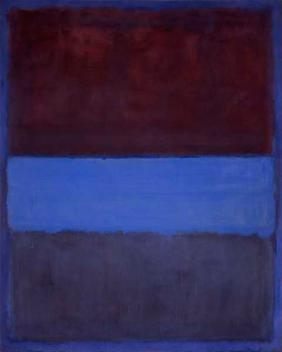
    Rothko

    Throughout Rothko's life acclaim never seemed to sooth his embattled spirit, he came to be known as a abrasive and combative character - much life Pollock. He was given an award by the Guggenheim Foundation but refused it as a protest against the idea that art should be competitive. He was always very confident in his beliefs "I am not an abstractionist" he once stated. He distanced himself from classification of his work as non objective colour filled paintings. Instead he stressed that his paintings were based solely on human emotion of tragedy ecstasy and doom. He also denied being a colourist - despite the fact colour was the primary importance of his work.
    His painting in the 1930's was influenced by Expressionism. However by 1940 he was influenced by Surrealism, so he abandoned expressionism for more abstract imagery. Rothko came to see mankind as locked in a mythic struggle with his free will and nature. In 1939 he briefly stopped painting altogether to read up on mythology and philosophy. It is likely Rothko was undiagnosed with bipolar disorder.
    His paintings were meant to entirely envelope the viewer. Rothko radically reduced the number of forms in his pictures and grew them such that they filled out the canvas. Painting consumed his life. Although he did not receive the attention he felt his works deserved in his own lifetime, his fame has increased dramatically in the years following his death.


    1890

    Art Nouveau 

    Art Nouveau was a movement in the visual arts popular from the early 1890's up to the First World War. It's influenced can be found in painting, sculpture, jewellery, metalwork, glass and ceramics. The drawings of Aubrey Beardsley and the poster designs of Alphonse Mucha are some of the most familiar examples of the style.
    Art Nouveau was a movement that swept through the decorative arts and architecture in the late 19th and early 20th century. This style was aimed at modernising design, seeking to escape the eclectic historical styles that had previously been popular. Artists drew inspiration from both organic and geometric forms. Designs were evolved from elegant, natural forms to something with more angular contours. The movements was committed to abolishing the tradition hierarchy of the arts. The style went out of fashion to give way for Art Deco in the 1920's but it did experience popular revival in the 1960's. It is now seen as an important predecessor of modernism.


    Aubrey Beardsley

    Aubrey was an English illustrator and author. His drawings in black ink, influenced by the style of Japanese woodcuts, emphasised the grotesque, the decadent, and the erotic. He was a leading figure in the Aesthetic movement which also included Oscar Wilde and James A. McNeill Whistler. Beardsley's contribution to the development of the Art Nouveau and poster style was significant. Despite the brevity of his career before his early death from tuberculosis. He co-founded The Yellow Book with american writer Henry Harland and for the first 4 editions served as art editor and produced cover designs and many illustrations for the magazine. Beardsley was the most controversial artist of the Art Nouveau era. Renowned for his dark and grotesque erotica (which later were main themes in his work), it wasn't the norm imagery of the time. His most famous erotic illustrations for a privately printed edition of 'Aristophanes Lysistrata' and his drawings for Oscar Wilde's play Salome, which eventually premiered in Paris in 1896.


    Alphonse Mucha

    During his life Mucha produced many paintings, posters, illustrations, postcards and advertisements. Many of which are now dedicated to an Art Nouveau Exhibition. The subjects of his art were almost always beautiful young women (not uncommon of the time), often with long flowing hair and neoclassical robes, usually surrounded by flowers and nature, sometimes formed halos behind them. The use of these women would later develop into a key signature of his style.
    Alphonse's success and rise to fame could be the plot of a modern day fairytale. According to a well known legend, Mucha met Sarah Bernhardt, the glorified star of french theatre in 1894, the day before christmas. Fresh out of Academie Julian, Mucha was working as an illustrator for a Parisian printer, when she came in. In desperate need for somebody to design the poster of her new show, Mucha rose to the occasion and created his first poster. Upon it's release he was the talk of the town. That earned Mucha a 6 year contract with the actress.
    Upon the industrial revolution and the increased development of consumerism in the 18th century, printing techniques became increasingly refined and more sophisticated. By the 19th century the streets of Paris were decked out with all kinds of posters from both the general public and artists. The medium gained more and more respect. The commercial poster became a Parisian trend and due to Mucha's previous success he emerged a star. He was commissioned a multitude of works from places like Moet & Chandon, Job and Nestle, Champenois. He soon became internationally recognised.
    He has influence on the development of decorative art and the Art Nouveau movement. Although Mucha didn't directly identify with the term.
    Many of his posters included focus on one or more female characters that are glorified in their sensuality and beauty. Surrounded by flowing lines and curves, evoking a certain spirituality strong bond to nature.

    1924

    Kurt Hermann Eduard Karl Julius Schwitters

    Schnitters was a German artists born in Hanover. He worked in several genres, including DaDa, Constructivism, Surrealism, Poetry, Sound, Painting, Sculpture, Graphic Design, Typography and what came to be known as installation art. His most famous works are his collages, named Merz Pictures.
    As the political climate in Germany became more liberal and stable, Schwitter's work became less influenced by Cubism and Expressionism. Schwitter's Published a periodical called Merz, between 1923-32.

    Dadaism is a complicated movement that generated in western Europe. It was centred around Germany, France and Switzerland. It started around 1916 and concluded around the 1920's. However Schwitters continued painting into the 30's. The artists in that cafe decided that DaDa represented their protests and anti-aesthetic actions. These actions came together from the mutual dislike towards the middle class and their bewailment over World War 1. Schwitters created a collage "The Hitler Gang" the artists rejected social standards of beauty and laws. In fact, many DaDa artists felt it was there place to demolish aesthetic standards by the use of irrationality in their paintings. In the 1920's the numbers started to dwindle and artists began moving to different expressionistic views. Most artists moved to surrealism. DaDa stayed in Germany and continued his DaDa movement through World War 2.

    1819

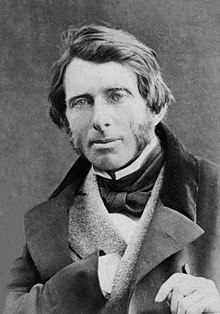
    John Ruskin

    John Ruskin was the leading English art critic of the Victorian era, he was also an artist himself, a prominent social thinker and philanthropist. A man of many talents. He wrote about subjects as varied as geology, architecture, myth, ornithology, literature, education, botany and political economy. His writing styles were as equally varied. But, in all of his writings he emphasised the connections between nature, art and society. He was largely influential in the later 19th century after the first world war. After a period of decline his reputation started to improve. Today, his ideas are recognised as having a high influence and anticipation on the environmentalism, sustainability and craft.
    From the 1850's he championed the Pre-Raphaelites who were influenced by his ideas. He first came into contact with Millais after the artists approached him through their mutual friend Coventry Patmore. Initially, Ruskin was uninterested and unimpressed with Millais's work, the piece was considered blasphemous at the time. But Ruskin wrote letters defending the piece later in 1851. Spurring Millais on in the summer of 1853 the artist and his brother travelled to Scotland with Ruskin where he painted the landscapes and later perhaps as a thank you Ruskin's portrait was added to the piece. After Ruskins divorce on the grounds of "non-consummation", his wife soon married Millais. Ruskin still continued to support Hunt and Rossetti, and financially supported Elizabeth Siddal, Rossetti's wife and he also supported other members of the Pre-Raphaelites financially. His work soon became more and more focused on social and political issues.
    From the late 1840's to 1842, Ruskin was abroad with his parents, mainly in Italy. He studied Italian art guided by George Richmond (english painter and portraitist 1809-1896). Before Ruskin began Modern Painters, John had begun collecting watercolours including work from Samuel Prout and in 1839, Turner.


    1846

    Pre-Raphaelites


    The Pre-Raphaelites are a group of English 19th century artists, originally known as the Pre-Raphaelite Brotherhood. They were inspired by the theories of John Ruskin, who urged any artist to 'go to nature'. They believed in a serious art subjects with maximum realism. Although they were initially religious they also used subjects from literature and poetry. Its main members of the group were William Holman Hunt, John Everett Millais and Dante Gabriel Rossetti. After some time of heavy opposition the Pre-Raphaelites became very influential. There was a second wave of a movement in 1860, particularly inspired by the work of Rossetti. It made a major contribution to symbolism. The artists ultimate goal was to consciously surpass the simplicity and sincerity of the work of Italian artists before the time of Raphael.

    Raphael - A leading figure of Italian High Renaissance classicism

    Raphael was an Italian painter during the high renaissance, his work is remembered for the clarity of form and the visual achievement of the traditionally ideal human grandeur of the time. The work he is best known for are his series of paintings known as 'madonnas' that he produced in 1504-07. Raphael along with, Michelangelo and Leonardo da Vinci formed the traditional trinity of great masters of that period. Raphael's work was extremely versatile and prolific more so than either of Michelangelo's or Leonardo's work. Leonardo created a series of work extended from Raphael's madonnas. I'm sure that even if you were not well schooled in art you would recognise their names, they were extremely influential in their lifetime and I would say they still held power over todays work. Raphael's movement toward Mannerism influenced painting styles in Italy. Raphael combined a mixture of rebellion, beauty, scientific precision and imaginative grandeur. The Pre Raphaelites constitute Britain's first modern art movement.


    Thursday, 5 May 2016

    1950s

    http://padlet.com/nncartanddesign/zg1qzmramhvy

    Thursday, 10 December 2015

    1875

    William Morris born on the 24th Marcher 1834 and died on the 3rd October 1896. Morris was an English textile designer, overall artists and writer. He is also widely known for his association with the Pre-Raphaelite Brotherhood and the English Arts and Crafts Movement. Morris trained as an architect when his ambitions to be a painter were unfulfilled. He met the artists Edward Burne-Jones during his time as a student at Oxford. Through this friendship he came into contact with the Pre-Raphaelite painters such as Rossetti and others within their circle.
    In 1859 Morris actually married Jane Burden - an unconventional beauty and a favourite model for the Pre-Raphaelites at the time. With his marriage to Jane he decided to build them a house. The Red house to be precise, it took them two years to decorate the interior of the home, in which Morris (with help of his friends within the Pre-Raphaelites) built and designed a lot of the furniture. Then, because of the success of the house interior Morris and Webb decided they would found a decorative arts firm, inviting the likes of Burne-Jones, Rossetti and others to work with him, "The Morris, Marshall, Faulkner & Co". The firm became immensely fashionable and in high demand in a short amount of time, the firm profoundly influenced interior decoration throughout the Victorian period. Morris designed things like tapestries, wallpaper, fabrics, furniture and even stained glass windows. 

    Morris concentrated on designing wallpaper during the 60s. His patterns were often inspired by the natural world, those pieces are some of his best known works of art.
     

    By 1875, Morris assumed complete control of the company and renamed the firm Morris & Co.
    Because Morris was also a poet there are a lot of famous quotes from him, the most famous probably being; "Have nothing in your house that you do not know to be useful, or believe to be beautiful." A lot of his poems were influence from the Icelandic sagas, his red house was also heavily influence from this saga. 
    By 1883 Morris joined a political party called the 'social democratic federation'. Then going on to start a new party called the 'socialist league'. 
    When Morris passed away in 1896 his doctor said Morris had 'carried out the work of ten men during his lifetime'.


    1933


    'A war on the modern imagination' Degenerate Art

    To be able to talk about the peril hitler caused I think you've got to first start with what caused him to do this. All the way back to the turn of the century. Hitler was an artist himself who was sent to war. He was of no particular importance during the war, just another soldier fighting a never ending battle but nevertheless he was a man with a mission after that. I think war can ruin anyone, especially trench war fare, surrounded by bodies for a year will do that to a person. But it effects someone so much more when they have a 'soft soul' and are much more sensitive than others (artists, musicians etc..) and thats what it did to Hitler. He said 'hatred ruined me' and I think that simple sentence perfectly describes exactly what the war did to him. That and his imprisonment, which I will come to later. After the war Hitler resolved to go into politics.
    In the 1920's the nazis were a small group which held no fear towards the expressionists, few people cared about Hitler and his fanatic ideas. It wasn't until Germanys fragile democracy was in turmoil that the people started to take note of what Hitler was saying. Berlin flourished at the time and it was a centre for art and all things 'degenerate'. In 1924 Hitler was released from his imprisonment which he then blamed on jews, communists, degenerates, he labeled expressionists 'artists like the mentally ill'. Hitlers break was the great depression. He thought that there was a 'sickness in society' all caused by degenerates, that they were effecting the pure race and even the culture. 
    Gradually as Hitler rose to power, where he attempted to 'cleanse' the nation of degenerates (artists, communists, jews, bolsheviks) to wipe them all out to become the purest race. Hitler made it so it was a science in the decision of who was a degenerate, there were symptoms and observations to be made. Basically what it came down to is if you didn't look a certain way you were a degenerate. 
    In 1933 Hitler was appointed chancellor as the fragile German democracy was near death. Hitler was in power less than 5 months when the Berlin book burnings came about and the war on modern imagination really started. Even artists who stood by the nazis were turned against. All forms of modern art was slandered. Hitler resolved to create a new world with no place for the weak or sensitive minds. Many artists emigrated to save themselves, although some stayed. One man said 'I painted landscapes as that was tantamount to immigration'. Paintings were confiscated and people then painted in water colour because if they painted in oils you could smell it and they were afraid of the outcome had anyone known what they 'were'/were doing.


    The Degenerate Art Show

    The degenerate art show was created to purposely slander modern art. It was described as a horror show. It was claustrophobic, the lighting was terrible, there was graffiti ridiculing the art work. What was not long ago seen as amazing new innovative art, painted by amazing, famous artists was now mocked. Artists were now criminals or 'jews'.
    The exhibition presented 650 different works of art from a variety of artists such as, Georg Grosz, Ernst Ludwig Kirchner, Emil Nolde and many others.
    Ernst was a German expressionist painter and a printmaker. He was also a key founder of a group called The Bridge which led to the foundation of Expressionism in 20th century art! Sadly, after his endeavour in the first world war he suffered a breakdown and was discharged. Ernst's life spiralled from there as when Hitler came to power his work was branded 'degenerate' and over 600 of his works were sold or destroyed. In 1938 Ernst committed suicide.
    Otto Dix was yet another classed as a degenerate artist that's lifestyle was taken when the Nazis came to power in Germany. Firstly Dix was sacked from his post as an art teacher, later his paintings like; The Trench and War Cripples were exhibited in the exhibition of degenerate art and later burned. Dix like a lot of other practising artists were forced into promising into only painting inoffensive landscapes. Dix still painted the occasional painting in his own style that the Nazi's criticised. In 1939 he was arrested on a charge of being involved in a plot against Hitler but was later released. 
    Max Beckmann luck changed with the rise of the Nazis. There dislike of modern art quickly deteriorated his life. In 1933 the Nazi government called Beckmann a "cultural Bolshevik" and he was then dismissed from his teaching position (much like Otto Dix). His work was confiscated and also put on display in the Degenerate Art exhibition, this led Beckmann to relocating himself and his second wife to the Netherlands.
    The day before the degenerate art show started Hitler delivered a speech declaring a "merciless war" of destruction against the last remaining elements of cultural disintegration. Hitler said "works of art which cannot be understood in themselves but need some pretentious instruction book to justify their existence will never again find their way to the German people."
    There were so many artists effected by the Nazi's ruling and many either fled the country or killed themselves. One million people attended the show in its first six weeks. The art show toured for four years and caused the death of art in Germany.


    House of German Art

    Hitler created a new exhibition, 2000 years of German Culture, which revealed a archaic past that had not happened. It was all new and 'genuine' forms of art, art that Hitler approved of. It was a celebration of racially pure classism and purity, art that everyone can easily understand. The majority of art work displayed were nudes, both female and male figures. These figures would hold no expression, no character, no joy. Someone described it as almost pornographic as it wasn't about the art and the joy of a painting it was just simply to celebrate and view the human form. It's noted that any Nazi paintings of women were either nude or mothers. 


    Tuesday, 22 September 2015

    Ai Weiwei

    Ai WeiWei - art activist
    Born August 28, 1957 is a Chinese contemporary artist and activist. He collaborated with Swiss architects for the 2008 Olympics. As a political activist he has been highly and openly critical with the Chinese government on democracy and human rights. He has investigated government corruption and cover-ups, in particular the Sichuan school corruption scandal with the collapse. He's done a lot of work that is controversial. Because of this he was actually imprisoned for 81 days by Chinese government. The situation was so severe they actually told him he would get 10 years minimum and he would 'never get out'. He was never beaten and fed well but he was under constant supervision, he created a piece of art work showing what it was like when he was in prison. It shows the constant supervision and no privacy he had during his time there. He reduced the scale for this sculpture drastically and I think he did that so as to make the whole sculpture seem more child like and like a game rather than real life.

    The sunflower seeds made from porcelain, 'made in china' is my favourite work he's done. I think what you see is not what you see with this piece, the sculptural installation is made up of millions of sunflower seeds and although they look extremely realistic they are made out of porcelain. They were all hand crafted by hundreds of skilled artisans. The precious nature of the material makes a powerful statement on human condition. Making the seeds from porcelain speaks volumes, using such a precious material rather than using clay which is the equivalent to mud you can link that to the society. Ai Weiwei has long challenged this reverence and high financial values attached to the material. Although he does this his works still show the exact same high standards in their perfect finish. To me, the sunflowers are the population, so the seeds on the floor and being 'walked over' are much like the population in that society.


    "From a very young age I started to sense that an individual has to set an example in society" Ai said. "Your own acts and behaviour tell the world who you are and at the same time what kind of society you think it should be". As material for his art, he draws on society and politics of contemporary China as well as cultural artefacts such as the ancient vases etc. The historical and cultural significance of the materials and techniques Ai Weiwei uses are an essential element of almost all of his sculptures.
    "You can't force someone to feel the same way but you are responsible to speak your mind".